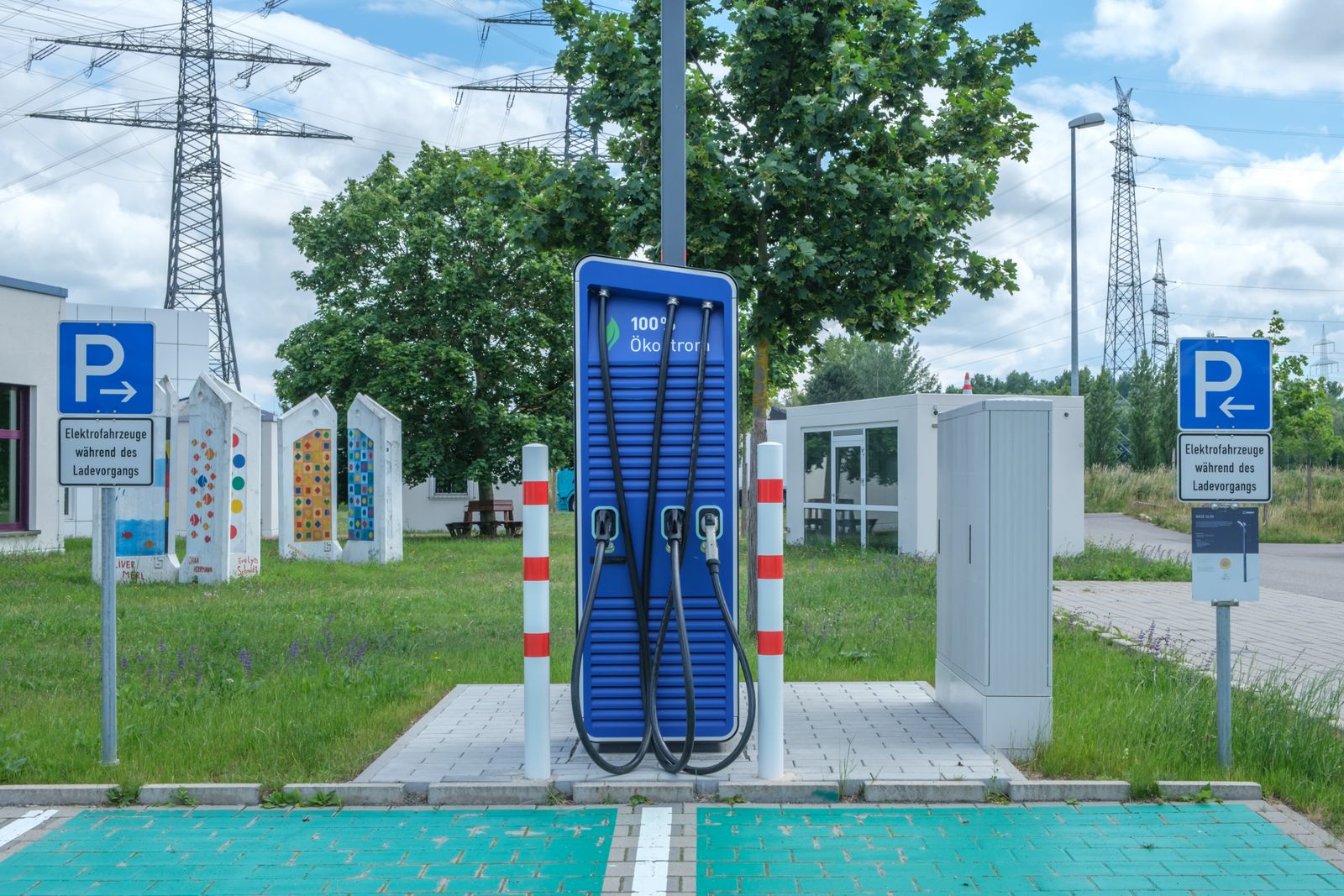
Ten years ago, an electric vehicle charging point in a Dubai parking garage was a curiosity, installed more as a statement of intent than a practical utility. Today it is closer to a checklist item — one that new developments are increasingly expected to have covered before a single unit is handed over.
The Numbers Behind the Shift
The scale of change in the city’s charging network is worth stating plainly. By the end of 2024, Dubai Electricity and Water Authority’s EV Green Charger initiative had more than 740 charging points spread across malls, business districts, residential communities, parks and government buildings. By the first quarter of 2026, the citywide total — including DEWA’s own network and stations run by licensed independent charge point operators — had reached 2,223 points. DEWA has since gone further, announcing plans to install 10,000 EV charging stations across Dubai by the end of 2026, backed by an AED 2 billion investment that includes free charging for a vehicle’s first 12 months and subsidised installation of home chargers for residents.
That trajectory changes the calculation for developers. A charging bay that once required special negotiation with a utility provider is moving toward being standard parking infrastructure, in much the same way covered parking or visitor bays became assumed rather than negotiated. The pattern extends beyond residential towers, too: in mid-2026, DEWA installed 46 EV charging points at Al Shera’a, a newly built government headquarters building, folding charging capacity directly into a major construction project’s original design rather than adding it after the fact, a small but telling illustration of where the city’s own building standards are heading.
Dubai’s Green Mobility Strategy 2030
The charging build-out sits inside a broader, published policy framework: the Dubai Green Mobility Strategy 2030, which sets concrete adoption targets rather than aspirational language. Among them: 10 percent of all vehicles sold in Dubai and 30 percent of public sector fleet vehicles are targeted to be electric or hybrid by 2030, with government procurement of electric and hybrid vehicles set to rise to 20 percent by 2025 and 30 percent by 2030. The strategy also targets 42,000 electric vehicles on Dubai’s roads — a figure the city is approaching faster than the timeline suggests, with more than 40,600 electric and hybrid vehicles already registered by mid-2025.
The strategy is explicitly positioned as a contribution to the wider Dubai Net Zero Carbon Emissions Strategy 2050, which treats road transport emissions as one of the sectors the emirate can most directly influence through infrastructure and procurement policy, rather than through demand alone.
What This Means for New Developments
For residential developments, the practical implications are becoming visible in the parking podium rather than the brochure. Charging bays — sometimes a handful, increasingly a meaningful share of total parking — are appearing as standard rather than optional in new launches, often through direct arrangements with DEWA or a licensed charge point operator rather than a bespoke, owner-initiated installation. DEWA’s subsidy for home charger installation extends that logic into villa communities, where a resident can add a dedicated charger to their own unit at a reduced cost rather than treating it as a discretionary renovation. In apartment and townhouse communities, the more visible shift is in the mix of charger types being specified: developments are increasingly pairing a small number of fast or ultra-fast points near entrances and visitor parking with a larger number of standard overnight chargers spread across resident bays, mirroring how DEWA has structured its own public network rather than treating every bay as identical.
The developments that treat this as core infrastructure now, while the network is still being built out, are effectively future-proofing their parking against a vehicle fleet the city’s own policy explicitly expects to keep growing.
Beyond the Charger
It is worth separating the charging point itself from the larger shift it represents. A charging bay is a convenience; the policy architecture behind it — a published strategy with dated targets, a utility-backed investment plan, and an explicit link to a 2050 emissions strategy — is a signal about where the city expects transport, and by extension property, to be headed over the next two decades. Developments built with that trajectory in mind are not simply accommodating today’s early EV owners; they are positioning themselves for a resident base the city’s own planning assumes will keep expanding. For a buyer weighing two otherwise comparable projects, the presence of a funded, phased charging plan tied to a named utility programme is a more reliable indicator than a developer’s own marketing claims about being future-ready, precisely because it can be checked against a public target with a stated deadline.
Frequently Asked Questions
How many EV charging points does Dubai have now?
DEWA’s EV Green Charger network passed 740 points by late 2024, and the citywide total — including DEWA’s stations and licensed independent operators — reached 2,223 points by the first quarter of 2026, with DEWA targeting 10,000 stations across Dubai by the end of 2026.
What are Dubai’s official EV adoption targets?
Under the Dubai Green Mobility Strategy 2030, the city targets 10 percent of all vehicles sold and 30 percent of public sector fleet vehicles being electric or hybrid by 2030, alongside a target of 42,000 electric vehicles on Dubai’s roads — a figure already above 40,600 as of mid-2025.
Is EV charging becoming standard in new Dubai residential developments?
Increasingly, yes. Developers are building charging bays into parking as standard infrastructure rather than a bespoke add-on, often through direct arrangements with DEWA or a licensed charge point operator, while DEWA’s subsidised home-charger programme extends the same shift into villa communities.
At Arsha Homes, we treat charging infrastructure the same way we treat any other utility question when assessing a development’s long-term fit for a buyer: not as a novelty, but as a piece of plumbing that either matches where the city is heading or falls behind it. Given Dubai’s own published targets, betting on the latter looks like the riskier position.