
A family weighing a move to Dubai will, sooner or later, meet a number — a ranking, an index, a percentage lifted from a survey. The figures tend to reassure, and for the most part they deserve to. Yet a statistic on its own explains very little about the texture of daily life. What follows is a plain reading of the safety data: what the rankings measure, how Dubai compares once the noise is stripped away, the institutions that sit behind the numbers, and where a careful buyer should hold a headline at arm’s length.
What the safety rankings actually measure
Two sources dominate the conversation, and they measure quite different things. Numbeo, the most widely cited, is a crowdsourced database: residents and visitors rate how safe they feel, and those responses are aggregated into a Safety Index and its mirror image, a Crime Index. A high Safety Index and a low Crime Index describe the same reality from opposite ends. Because the data is drawn from perception rather than police records, it captures confidence — how people experience a place — more than it counts individual offences.
The second source, Gallup’s Global Law and Order report, asks a simpler question: do you feel safe walking alone at night where you live? In the UAE, roughly 95 per cent of residents answer yes — a figure that sits above most Western nations. Both measures are useful, and both are perception surveys. Neither is a raw crime ledger, and reading them well means keeping that distinction in mind.
How Dubai compares, once you look closely
On the 2025 numbers, the UAE ranked as the second-safest country in the world, with a national Safety Index near 84.5. The country is not uniform, however. Abu Dhabi scores highest at roughly 88.8, Ajman around 85.5, and Dubai near 83.7 — differences that are real but modest, and all comfortably within the range that international comparisons treat as very safe.
Dubai’s own crime index sits near 15.5, where lower is better, placing it among the top ten safest major cities measured. In practice this means violent crime is rare and petty crime — the pickpocketing and opportunism common to most large cities — is minimal rather than absent. For a family, the more telling detail is often that women report feeling safe moving around the city alone, by day and after dark; harassment is uncommon and treated seriously when it occurs.
A few figures worth holding together:
- UAE: second-safest country globally in 2025, Safety Index around 84.5.
- Abu Dhabi around 88.8, Ajman around 85.5, Dubai around 83.7 on the same index.
- Dubai crime index near 15.5 — among the ten safest large cities measured.
- Around 95 per cent of UAE residents say they feel safe walking alone at night.
The infrastructure behind the numbers
Rankings describe an outcome; they say little about how it is produced. In Dubai the answer is partly visible and partly not. More than 300,000 CCTV cameras are monitored around the clock, and policing has moved steadily towards what the authorities term smart policing — AI-assisted monitoring and facial recognition that shorten response times and raise the likelihood that an offence is seen. The effect is less a heavy uniformed presence than a quiet sense that the city is attentive.
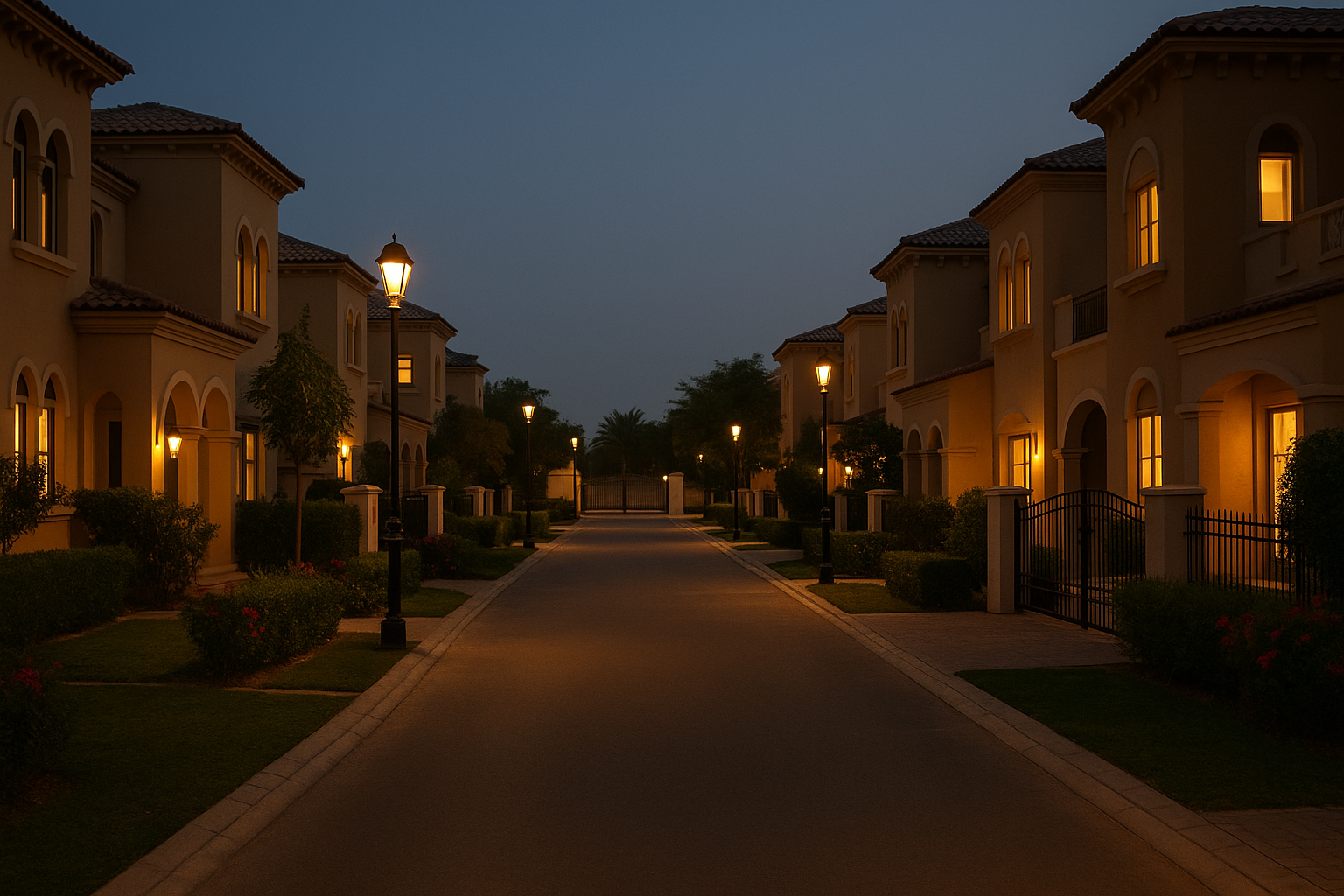
At the residential level, most family communities are gated and monitored, with parks and play areas designed into the plan rather than added later. The result is an environment where children have room to move and parents have fewer reasons to worry — the ordinary infrastructure of ease.
Rule of law and the weight of deterrence
Behind the cameras sits a legal framework known for consistency and for penalties that are actually applied. Laws are strict and enforced without much variance, which does two things at once: it deters, and it makes the environment predictable. Predictability is underrated in a safety conversation. A resident generally knows what is and is not tolerated, and that clarity is itself a form of security.
The wider context reinforces the impression. The dirham is pegged to the US dollar, healthcare and infrastructure are strong, and low crime is consistently cited by relocating families as a core reason for the move rather than a happy footnote.
What a ranking can — and cannot — tell you
For all their usefulness, indices have limits a buyer should respect. Perception surveys measure sentiment, which can lag or lead reality. National averages flatten the differences between one community and the next. And a strong ranking is a floor, not a personal guarantee — it describes the odds, not any single street on any single evening.
The sensible approach is to treat the numbers as directional. Let them confirm that the fundamentals are sound, then verify at the level that actually shapes daily life: the specific community, its access control, the walk between home and school, the feel of the streets after dark. A ranking earns a family’s confidence; a neighbourhood earns their comfort.
We are glad to walk clients through what the figures mean for a specific address, quietly and without pressure.