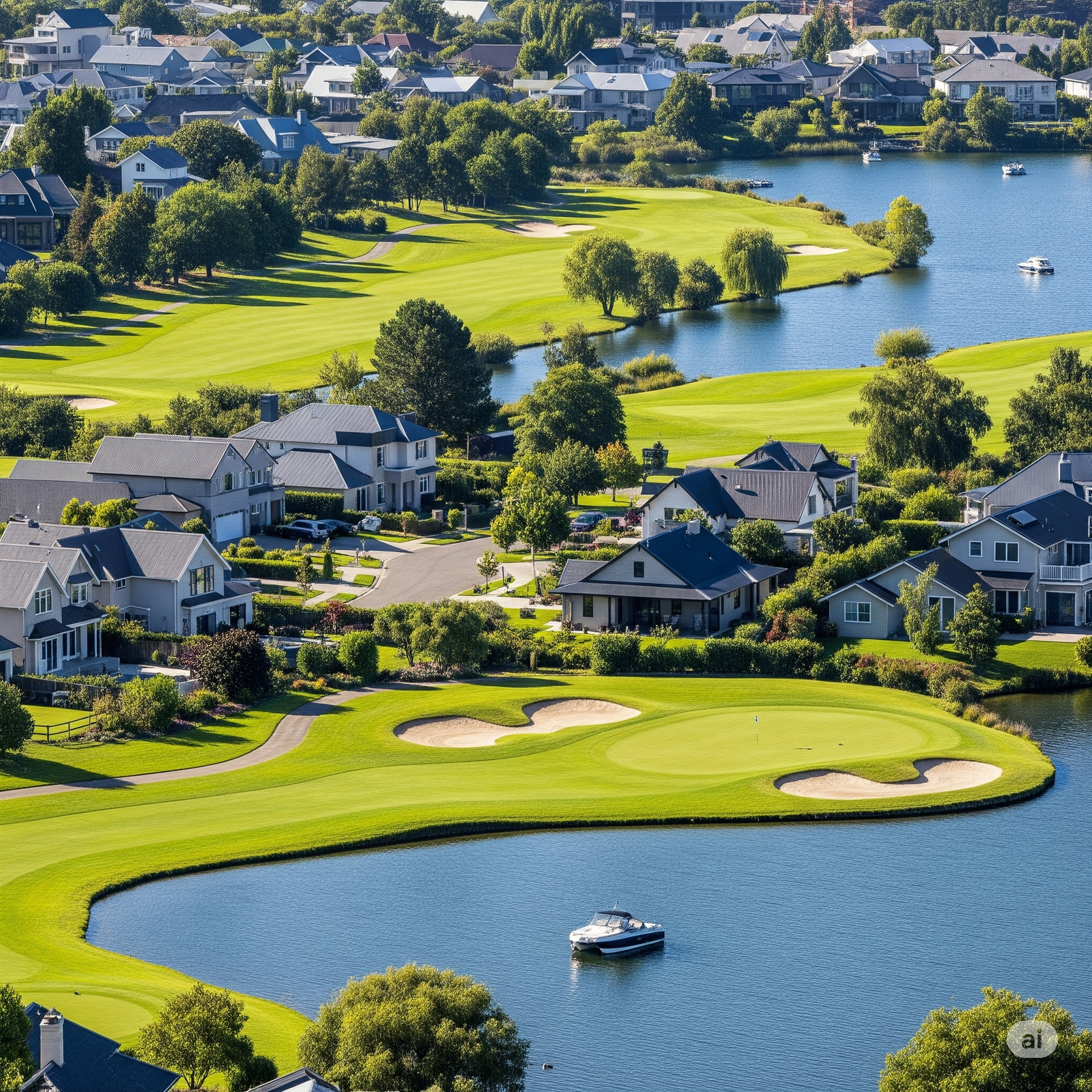
There is a particular kind of quiet that settles over Dubai Hills Estate in the early evening, once the fairways empty and the light over Dubai Hills Park turns amber. It isn’t the quiet of a suburb still waiting to be discovered — it’s the quiet of a masterplan that already knows what it is. Nearly a decade into its build-out, Dubai Hills Estate has stopped being a promise on a brochure and become one of the more convincing arguments in Dubai for buying into a place, not just an address.
Why Dubai Hills Estate Matters
Emaar’s master development, anchored inside Mohammed Bin Rashid City, wraps a series of distinct sub-communities — Sidra, Maple, Golf Place, Fairway Vistas, Parkway Vistas, Club Villas, Golf Grove and the Hills Park apartment collection among them — around an 18-hole championship golf course threaded through the centre of the community. That structure matters more than any single amenity: it means Dubai Hills was designed as one coherent piece of city, not a patchwork of towers competing for the same retail footfall.
Since Dubai Hills Mall opened in February 2022 — close to two million square feet of leasable space, more than 650 stores, over 90 restaurants, an indoor adventure park with a roller coaster and climbing walls, and Roxy Cinemas — the community has had the kind of anchor most Dubai neighbourhoods spend a decade waiting for. Add a working golf course and a public park spanning close to 180,000 square metres, with splash pads, a skate park and outdoor gyms, and it becomes clear why Dubai Hills Estate is routinely described, without much argument, as one of the greenest large-scale communities in the city.
The Investment Case
Emaar’s brand, the golf-course frontage, and a genuinely limited supply of villa plots have kept capital values on a steady footing over the past several years, even through periods when other parts of the market cooled. Occupancy across the master community stayed above 94% through the first half of 2026, driven by tenants who stay for years rather than months — professionals renting long-term, families enrolling children in schools inside or immediately adjacent to the community.
On yield, Dubai Hills plays a different game than the highest-return postcodes in Dubai, and that is precisely the point for a certain kind of buyer. Apartments in the community typically return in the region of 6–8% gross, townhouses tend to sit closer to 5–6%, and villas — the more capital-intensive end of the market — usually land between 4–6%, with some golf-facing product, such as Golf Grove, cited around the high end of that range. Read differently: Dubai Hills isn’t trying to out-yield Dubai’s value communities. Its case is compounding rather than current income — appreciation built on scarcity of golf-course land, an Emaar signature, and a mall that keeps getting busier.
- Emaar as sole master developer — one design language, one long-term maintenance standard, no fragmented service-charge disputes across competing developers.
- Genuinely limited villa and townhouse supply set against a mall, school and hospital ecosystem that keeps expanding around it.
- Long-tenured tenants and occupancy above 94% through H1 2026 — a rental book built on families and professionals rather than short-stay churn.
Who Dubai Hills Estate Suits
This is, first and foremost, a family community. Green spaces, pedestrian-friendly streets and a genuine sense of enclosure make it one of the more convincing “raise children here” arguments in Dubai, reinforced by GEMS World Academy sitting inside the community itself and GEMS Wellington Academy, GEMS New Millennium School and Kings’ School Al Barsha a short drive away. King’s College Hospital operates within the community, with Aster Clinic and Mediclinic Parkview Hospital nearby for anything routine healthcare demands.
Investors, meanwhile, are drawn to something less visible than the golf course: liquidity. Emaar resale product in a recognisable, well-run community tends to move faster and more predictably than boutique developments elsewhere, which matters as much at exit as it does at entry. And for parents currently commuting into Downtown, Business Bay, DIFC or Dubai Marina, Dubai Hills offers a genuine trade — a quieter, greener base without sacrificing the commute.
Lifestyle and Connectivity
Al Khail Road (E44) and Sheikh Mohammed Bin Zayed Road (E311) run along the community’s edges, putting Downtown Dubai roughly 20 minutes away by car and Dubai Marina around 15. It is, in effect, a green pocket dropped within easy reach of the city’s two main employment corridors.
The one honest caveat: Dubai Hills Estate does not yet have its own Dubai Metro station. The nearest connection is at Mall of the Emirates, roughly a 20-minute bus journey away, and while future extensions have been discussed, nothing is confirmed. For a household with at least one car — which describes the overwhelming majority of Dubai Hills residents — this is a non-issue. For a buyer weighing walk-to-metro convenience above everything else, it is worth factoring in honestly rather than glossing over.
Frequently Asked Questions
Who is the master developer of Dubai Hills Estate?
Dubai Hills Estate is developed by Emaar Properties as the flagship residential component of Mohammed Bin Rashid City (MBR City). Emaar controls the masterplan, the golf course, Dubai Hills Mall and the public park system, which gives the community a level of design and maintenance consistency that multi-developer neighbourhoods often lack.
Does Dubai Hills Estate have Metro access?
Not yet. There is currently no Dubai Metro station within Dubai Hills Estate, and the nearest station is at Mall of the Emirates, around 20 minutes away by bus. Residents rely primarily on private cars, supported by Al Khail Road and Sheikh Mohammed Bin Zayed Road for fast access to Downtown Dubai and Dubai Marina. Future metro extensions have been discussed but nothing is confirmed for the community itself.
What kind of rental yields can owners expect in Dubai Hills Estate?
Yields vary by property type rather than by a single community-wide figure. Apartments generally perform strongest, in the region of 6–8% gross, with townhouses around 5–6% and villas typically between 4–6%, though well-positioned golf-facing villas can outperform that range. Occupancy across the community stayed above 94% through the first half of 2026, reflecting long-term tenant demand rather than short-stay turnover.
Dubai Hills Estate rewards buyers who think in years rather than quarters — a community built by one developer, anchored by a working golf course and a mall that keeps drawing people back, and populated by families who tend to stay. For anyone weighing a golf-facing villa, a Hills Park apartment, or simply comparing Dubai Hills against the city’s other master-planned communities, Arsha Homes can help identify which sub-community and unit type genuinely fit the brief, and where the better opportunities sit inside the wider MBR City picture.