Dubai property coverage tends to gravitate toward the same handful of buyer stories, and for good reason, those flows are large and well documented. But sit in on a developer’s sales floor on any given week and a quieter pattern becomes just as noticeable: a French couple comparing school catchments near Jumeirah, a German entrepreneur asking pointed questions about title deeds and exit strategy, an Italian family weighing a second home against a primary relocation. Continental Europeans are not the headline nationality in Dubai real estate, but their footprint has been growing steadily, and the reasons behind it say as much about Europe as they do about Dubai.
The Buyers Who Do Not Make the Headlines
Industry trackers watching 2025 and early 2026 transaction data have consistently flagged German and French buyers as among the fastest-growing segments in the market, both in the number of deals and in average transaction size, even though their combined share still trails the market’s largest source countries. The scale is not trivial: French investor activity in Palm Jumeirah alone was estimated at roughly AED 1.6 billion in 2025, a striking figure for a single nationality in a single address. That growth has arrived against the backdrop of a broader market expansion, with total residential transaction value across Dubai reaching close to AED 540 billion in 2025, an increase of nearly a quarter over the prior year. European buyers are not driving that total on their own, but they are a rising current within it.
What Is Pushing Continental Europeans Toward the Gulf
The pull factors are familiar: zero personal income tax, no capital gains tax, no annual property tax, and a currency and regulatory environment that has stayed comparatively stable while parts of the world have not. What is less often discussed is the push factor sitting quietly on the other side of the ledger. Mature European property markets, London, Paris, Berlin among them, have been contending with stagnating rental yields and slow capital appreciation, a sharp contrast to the returns still available in parts of Dubai. For a European investor accustomed to yields in the low single digits, a market offering meaningfully more, alongside a tax structure that leaves more of that return intact, does not require much persuading.
There is a domestic story pushing from behind as well as one pulling from ahead. Years of comparatively high inflation, tightening mortgage lending, and constrained new supply in several major German and French cities have made local property feel both less accessible and less rewarding than it once did, particularly for buyers who had assumed steady, low-effort appreciation as a given. That squeeze at home, paired with an increasingly well-understood, English-language-friendly market in the Gulf, has done more to normalise a Dubai purchase for an ordinary affluent European professional than any single marketing campaign could.
France, Germany, Italy: Three Routes to the Same Destination
The motivations differ enough by nationality to be worth separating out. German buyers in this cycle skew heavily toward high-net-worth individuals making a more complete shift of their financial and residential base to the UAE, a move often bound up with exit tax planning and a desire for a genuine alternative to Germany’s high personal tax environment, rather than a simple holiday-home purchase. French buyers have shown particular concentration in trophy addresses like Palm Jumeirah, suggesting a mix of lifestyle motivation and wealth preservation rather than pure yield-chasing. Italian interest, while smaller in absolute volume, has grown alongside a broader wave of European relocation enquiries tied to the UAE’s Golden Visa programme, which offers long-term residency to qualifying property investors and has become a meaningful draw for Italians facing a comparatively heavier domestic tax and bureaucratic burden. Different starting points, in other words, converging on the same city.
Where They Are Buying, and Why It Matters
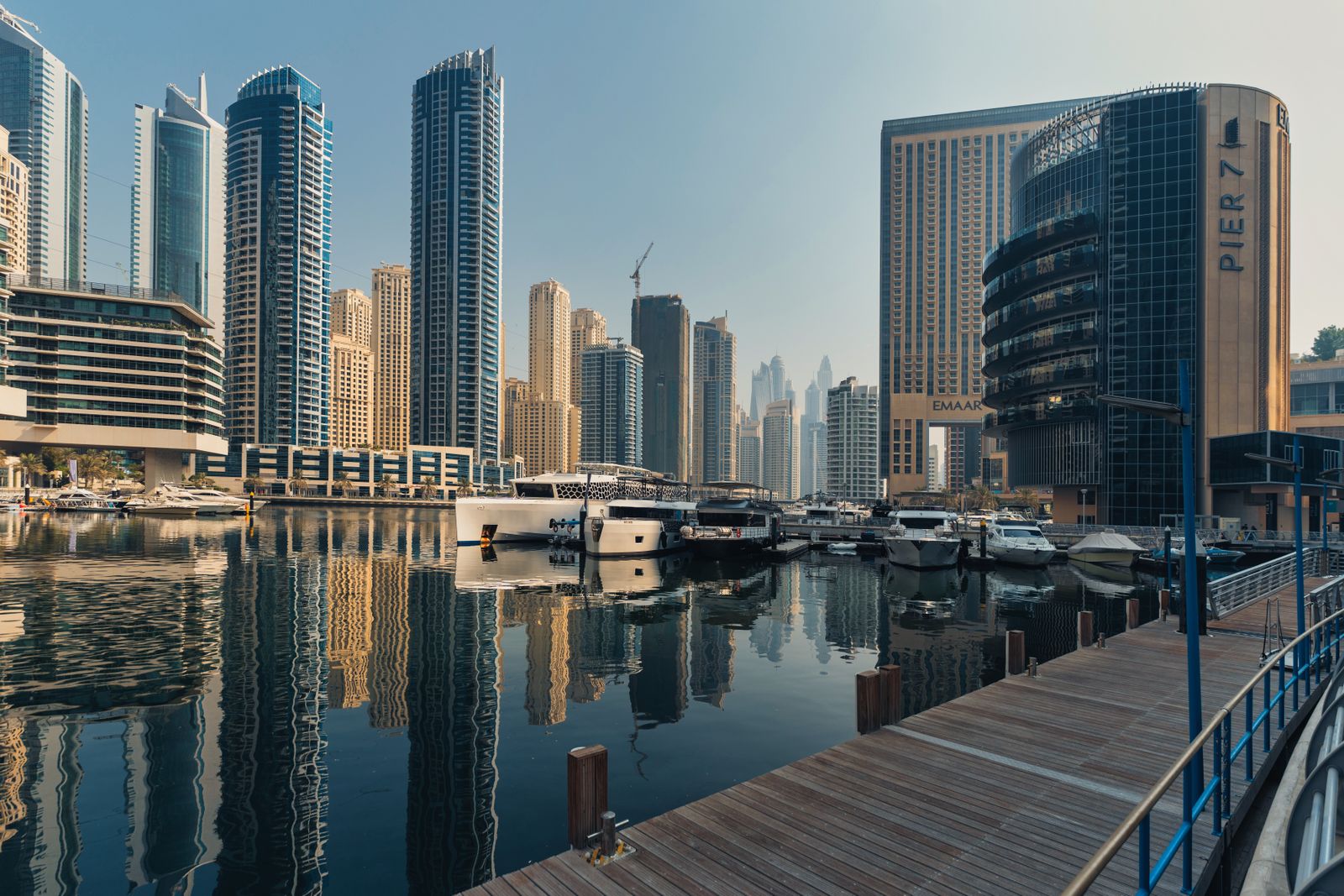
European buyers have gravitated toward established, internationally legible addresses, waterfront communities like Palm Jumeirah and Dubai Marina, branded residences with recognisable operators, and increasingly the newer master-planned districts that offer the kind of walkable, amenity-rich living many are used to at home. This is a meaningfully different buyer profile from a purely speculative off-plan flipper: many are planning to spend real time in the properties they buy, whether as a second home, a retirement base, or the anchor of a broader relocation, and that intent shows up in what they choose and how they hold it. For the market as a whole, a more geographically diverse buyer base, less concentrated in any single source country, tends to be a more resilient one, less exposed to a downturn or policy shift in any single part of the world.
It is worth noting how differently this segment behaves compared with the more transactional, yield-first buying patterns often associated with other fast-growing nationalities in Dubai. European buyers, on the whole, arrive with longer time horizons and a genuine intention to use what they buy, whether for a few weeks a year or as a full relocation, which tends to translate into steadier demand for finished, livable communities over purely speculative launches. Developers courting this audience have responded accordingly, with a noticeable uptick in European-facing sales offices, French and German-speaking advisory teams, and marketing pitched around lifestyle and legacy rather than short-term flip potential.
Frequently Asked Questions
Which European nationalities are most active in Dubai’s property market right now?
German and French buyers have been the most frequently cited as fast-growing segments in recent market data, with Italian interest rising alongside them, often connected to Golden Visa enquiries. Together they form a smaller but increasingly visible share of the market compared with its largest source nationalities.
Why are European buyers choosing Dubai over property markets closer to home?
A combination of factors: Dubai’s tax-free structure around income, capital gains, and annual property ownership, rental yields that have outpaced many mature European cities, and, for some buyers, a strategic decision to diversify residency and wealth away from a single domestic tax regime.
Do European buyers need to relocate to the UAE to invest in Dubai property?
No. Many European buyers purchase as a second home, an investment, or a future retirement base without an immediate move, though a growing subset, particularly among wealthier German buyers, are structuring purchases as part of a fuller relocation of their financial and residential base.
At Arsha Homes, we have watched this shift unfold conversation by conversation as much as in the data, and it has shaped how we brief the European clients who come to us: less about a single hot postcode, and more about matching a genuinely diverse set of European motivations, tax, lifestyle, legacy planning, to the right corner of a city built to accommodate all three.