
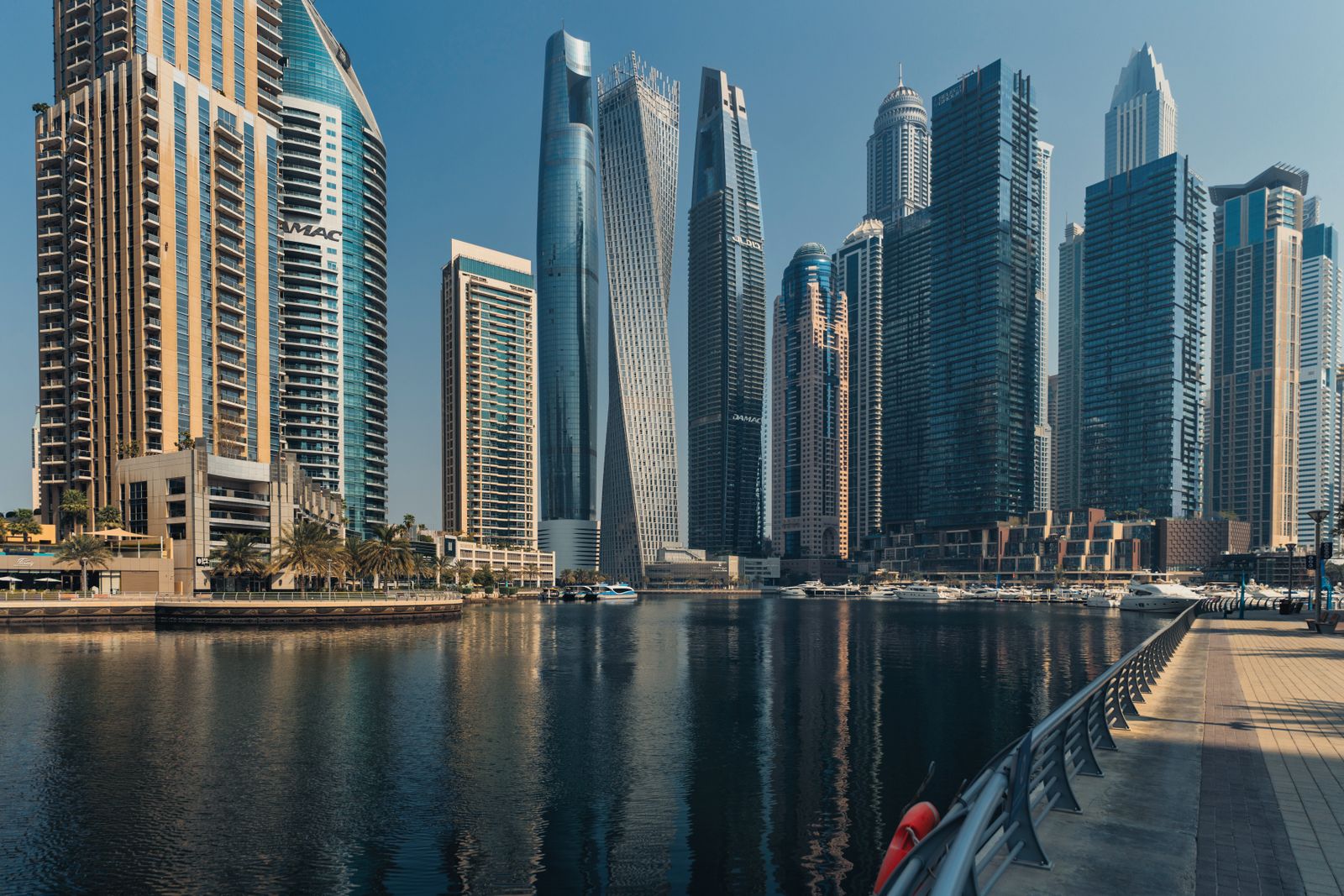
No Income Tax, No Capital Gains, One Fee at the Door
The UAE’s fiscal treatment of individuals is unusually simple to describe, which is itself part of its appeal. There is no personal income tax on salaries, dividends, or investment income earned by individuals. There is no capital gains tax on the sale of property held by an individual. There is no recurring annual property tax of the kind that shows up as a yearly bill in the United States, the United Kingdom, or most of continental Europe. The closest thing to a transaction cost is the Dubai Land Department’s transfer fee, currently set at 4% of the sale value, paid once at the point of registration rather than levied annually for as long as the owner holds the asset.
By convention that 4% is usually paid by the buyer at closing, though the underlying regulation — an Executive Council resolution dating to 2013 — technically splits it 2% and 2% between buyer and seller, with the market norm of buyer-pays-all being a matter of negotiation rather than law. Beyond the transfer fee, buyers typically budget for a handful of smaller registration and agency costs, but there is no equivalent of a US property tax bill, a UK stamp duty land tax scaled well beyond Dubai’s rate for higher-value purchases, or a French taxe foncière arriving every year regardless of whether the owner ever visits the property.
It is worth noting, in the interest of precision, that this is not a blanket absence of taxation across the economy. The UAE introduced a federal corporate tax of 9% on business profits above a set threshold in 2023, applying to companies rather than to individuals’ personal income or personal property gains. The distinction matters for describing the model accurately: Dubai’s tax advantage for a foreign property investor is specific and front-loaded — one fee, paid once, at the transaction — rather than the product of a jurisdiction with no fiscal apparatus at all.
Switzerland’s Cantons and the Cost of Discretion
Switzerland’s reputation as a wealth haven was built over most of a century on a combination of political neutrality, currency stability, and banking secrecy, and it remains a serious destination for cross-border capital today. But its tax model is materially different from Dubai’s on the two points that matter most to a property investor. Switzerland levies a personal income tax, with rates that vary by canton and commune and can be meaningfully progressive in higher-tax cantons such as Geneva, alongside more favorable rates in cantons such as Zug or Schwyz. Less widely discussed outside tax planning circles is that most cantons also apply an annual net wealth tax — a recurring levy on an individual’s total net assets, not just income — a category of tax with no equivalent in Dubai at all.
The secrecy that once defined Swiss private banking has also substantially eroded. Under pressure that built through the 2010s, including US enforcement action against Swiss banks and coordinated pressure from EU governments, Switzerland adopted the OECD’s Common Reporting Standard for automatic exchange of financial account information, phasing in from 2017. Swiss bank details are now routinely shared with a client’s home tax authority under that framework, which has fundamentally changed what Swiss banking privacy means in practice compared to a generation ago.
None of this makes Switzerland a poor destination for wealth — its political and economic stability remain genuine draws, and many investors hold Swiss assets specifically for reasons unrelated to tax. But as a direct comparison on the tax treatment of income, wealth, and property ownership, it is a materially heavier regime than Dubai’s, trading a lower headline tax burden for the kind of institutional and political stability that comes with a long-established, highly regulated financial center.
Singapore’s Wall Around Its Own Housing Market
Singapore is frequently mentioned alongside Dubai as a magnet for regional and global wealth, and on personal income tax alone the comparison is not unflattering to Singapore — its progressive rate structure tops out well below many Western economies. Where the comparison breaks down sharply is real estate specifically. Singapore applies an Additional Buyer’s Stamp Duty, layered on top of a standard Buyer’s Stamp Duty of up to 6%, and for foreign buyers that additional duty currently sits at a flat 60% of the purchase price — a rate that has held since April 2023 and was left unchanged in the most recent budget cycle. A small number of nationalities are exempt under bilateral free trade agreements, but for the large majority of foreign buyers, the tax alone adds well over half the property’s price again to the cost of acquisition.
This is not an oversight or a legacy rule Singapore has simply never updated — it is a deliberate, actively managed policy lever. Singapore has raised ABSD rates on foreign buyers repeatedly over the past decade specifically to cool domestic property demand and keep housing accessible to citizens and permanent residents, a policy goal that sits in direct tension with courting foreign real estate capital. It is a legitimate and, by most measures, effective use of fiscal policy toward a domestic housing objective.
The relevant contrast for a cross-border property investor is one of design intent rather than one jurisdiction simply taxing less than another. Singapore’s fiscal architecture is built to welcome foreign wealth into its banking and business sectors while actively discouraging foreign capital from its residential property market. Dubai’s is built to invite both simultaneously — foreign ownership in designated freehold zones has been permitted since 2002, without an equivalent foreign-buyer surcharge.
Monaco’s Tax Advantage, Priced for Entry
Monaco offers what is, on paper, one of the more complete tax exemptions available anywhere: no personal income tax for residents, no wealth tax, no capital gains tax, a policy that has held since 1869 with a narrow exception for French nationals under a bilateral treaty. In that narrow sense it resembles Dubai’s model more closely than Switzerland’s or Singapore’s does.
The difference is almost entirely one of accessibility. Monaco is a sovereign city-state of roughly two square kilometers, and residency approval requires proof of accommodation — typically a purchase or long-term lease of Monégasque property, which sits among the most expensive real estate anywhere in the world on a per-square-metre basis — along with a substantial minimum bank deposit and a discretionary approval process. The tax treatment is real, but it functions less as an open invitation and more as a benefit rationed by the cost and difficulty of qualifying for residency in the first place, which keeps the population of beneficiaries small by design as much as by tax policy.
Dubai’s freehold property market, by contrast, has no equivalent price floor for entry into the tax and residency benefits tied to ownership — a qualifying property purchase can support a renewable residency visa at a fraction of what an equivalent foothold in Monaco would require, widening the pool of investors who can access broadly comparable tax treatment.
Portugal’s Now-Closed Door
Portugal’s Non-Habitual Resident regime, introduced in 2009, offered new residents up to ten years of reduced or exempt taxation on qualifying foreign-source income, and it drew a substantial wave of relocations — retirees, remote-income earners, and investors — from across Europe and beyond. The program is a useful case study for a different reason than Switzerland, Singapore, or Monaco: it illustrates that favorable tax regimes can be withdrawn.
Under the 2024 State Budget Law, Portugal closed the NHR regime to new applicants effective January 1, 2024, with a limited transitional window running through March 31, 2025, for individuals who could demonstrate they met specific pre-existing conditions, such as an employment contract or property arrangement already in place before the cutoff. Those who had already registered under NHR before the change, or who qualified during the transition window, retain their benefits for the original ten-year term. In place of the broad regime, Portugal introduced a considerably narrower successor — commonly referred to as NHR 2.0, formally the Tax Incentive for Scientific Research and Innovation, or IFICI — offering a flat 20% rate on qualifying Portuguese-source income, but restricted to specific professional categories tied to research and innovation activity, rather than the wide eligibility that made the original program attractive to a broad cross-section of foreign wealth.
The reversal followed several years of domestic political pressure, much of it tied to concerns that the influx of NHR-status residents was contributing to rising housing costs for Portuguese citizens — a dynamic worth noting because it is close to the mirror image of what drove Singapore’s ABSD increases. Both cases point to the same underlying risk for any cross-border investor: a favorable regime built for foreign residents can become a domestic political liability once local housing affordability becomes the more urgent story.
The Combination, Not Any Single Number
None of this is meant to suggest Dubai holds a monopoly on favorable tax treatment — each of these jurisdictions offers a genuine advantage on at least one axis, whether that is Switzerland’s institutional stability, Singapore’s income tax structure for those not buying property, or Monaco’s absolute exemption for those who can clear its entry requirements. What differentiates Dubai is less a single number than the combination: no personal income tax, no capital gains tax on an individual property sale, no recurring annual property tax, a one-time and comparatively modest transaction fee, freehold ownership open to foreign buyers since 2002, and a residency pathway tied directly to property investment rather than a discretionary approval process or a research-specific eligibility filter.
Each of the four comparisons above trades away one part of that combination. Switzerland keeps income and wealth taxation intact. Singapore keeps its income tax advantage but specifically taxes foreign ownership of residential property, at a rate that has moved upward more than once. Monaco keeps the tax exemption but prices out all but a narrow band of buyers through the cost of qualifying residency. Portugal offered a genuinely comparable package for over a decade, until a shift in domestic politics narrowed it to a fraction of its original scope.
That last point is the more sober one to end on. A tax regime’s generosity today says little about its durability tomorrow, and every jurisdiction discussed here, Dubai included, operates its fiscal policy as a matter of domestic political choice rather than permanent constitutional guarantee. What can be said, based on the record so far, is that Dubai’s specific combination of tax treatment, ownership rights, and accessibility for foreign buyers has proven more consistent over the past two decades than at least two of the models most often held up as its peers — one narrowed sharply under political pressure, and the other has raised its foreign-buyer cost repeatedly in the same window Dubai’s has stayed flat.
Frequently Asked Questions
What are the tax benefits of investing in Dubai real estate?
Investing in Dubai real estate offers no personal income tax, no capital gains tax, and a one-time transfer fee of 4% paid at the point of registration, making it an attractive option for foreign property investors.
How does Dubai's tax model compare to Switzerland?
Unlike Dubai, Switzerland imposes personal income tax and an annual net wealth tax, making its tax regime heavier for property investors compared to Dubai’s simpler and more favorable model.
What is the Additional Buyer's Stamp Duty in Singapore?
Singapore applies an Additional Buyer’s Stamp Duty of 60% for foreign buyers, significantly raising acquisition costs, in contrast to Dubai, which has no equivalent surcharge for foreign property investors.
What residency benefits come with buying property in Dubai?
Purchasing property in Dubai can support a renewable residency visa, providing easy access to residency benefits without the high costs associated with places like Monaco.
Can tax regimes change for foreign investors?
Yes, tax regimes can change due to domestic political pressures, as seen in Portugal’s recent restrictions on its Non-Habitual Resident program, illustrating the need for investors to stay informed.