
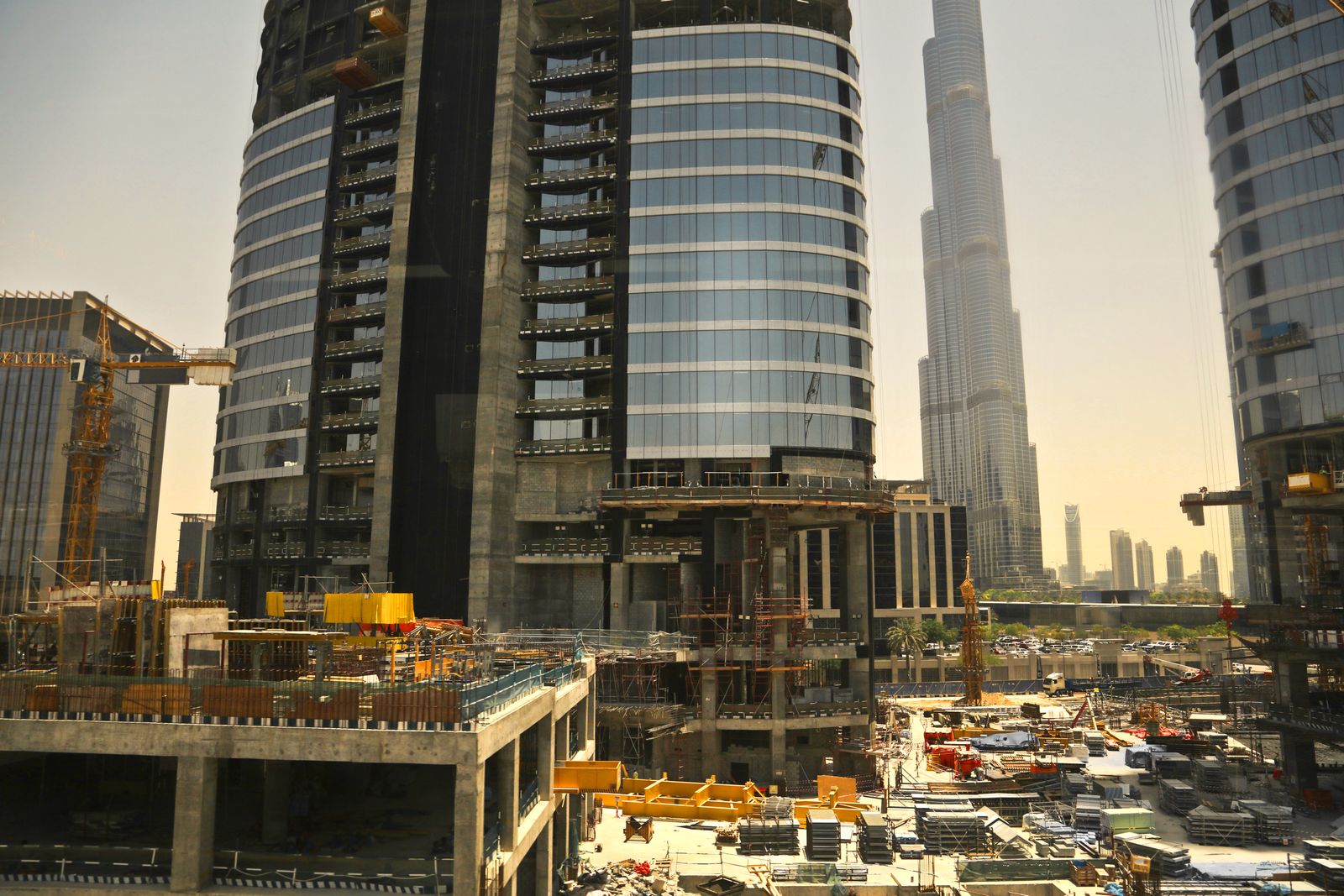
Every property market has a version of this question, but Dubai asks it more insistently than most, because the two answers genuinely produce different assets. Off-plan means buying a unit that exists on paper: a floor plan, a payment schedule, a projected handover date, and a developer’s track record standing in for the building itself. Ready property, sometimes called secondary or completed property, means buying something you can walk through today, with a title deed, a service charge history, and neighbors already living in the tower next door. The distinction sounds procedural. It is not. It changes what kind of risk you are taking on, what kind of return you can realistically expect, and what kind of buyer you need to be to make either option work.
Roughly speaking, off-plan sales have made up somewhere in the region of half to two-thirds of Dubai’s residential transaction volume in recent years, depending on the reporting period and how secondary assignment sales are counted — a reminder that this is not a niche corner of the market but, by transaction count, close to its center of gravity. That scale exists because the two products are not competing for the same buyer. They are answering different questions.
What “Off-Plan” Actually Means in the Dubai Market
An off-plan purchase in Dubai is a contract with a developer for a unit that has not yet been completed, sometimes not yet broken ground. The buyer signs a Sale and Purchase Agreement, the transaction is recorded on the Dubai Land Department’s Oqood register — the interim system that logs off-plan sales before a title deed can be issued — and payments are released against a construction-linked or calendar-linked schedule rather than paid in full at signing. The building, in a meaningful sense, is being financed partly by its future owners.
This is not unique to Dubai, but Dubai has built more infrastructure around it than most markets, largely because of how badly earlier cycles handled this exact transaction. Developer accounts for off-plan projects are required to sit in RERA-regulated escrow, with drawdowns tied to verified construction progress rather than released freely to the developer on receipt. That escrow requirement is the single biggest structural difference between buying off-plan in Dubai today and buying off-plan in Dubai in, say, 2008, when undercapitalized developers routinely used one project’s incoming payments to keep an unrelated project alive. It does not eliminate delay risk. It does substantially reduce the risk of a project collapsing because the developer ran out of cash for reasons that had nothing to do with the specific building the buyer paid into.
Ready property, by contrast, is exactly what the name suggests: a completed, handed-over unit with its own title deed already issued in the current owner’s name, available for immediate transfer, immediate occupation, and — for investors — immediate rental income. There is no construction risk because there is no more construction. What you inspect is what you get, which sounds obvious until you compare it to a floor plan and a set of finish-quality renders that may or may not survive contact with an actual handover.
How Off-Plan Payment Plans Are Actually Structured
The mechanics of off-plan payment plans are where the theoretical advantage of buying early turns into a concrete cash-flow decision, and the structures on offer from Dubai’s major developers vary more than buyers often expect. Sobha Realty has tended to keep its plans construction-linked and comparatively conservative — a large share of recent launches have sold on roughly a 60/40 structure, meaning 60% of the price is paid across construction milestones and the remaining 40% falls due at or near handover, with little to no post-handover tail. Emaar has offered a wider spread, with 50/50, 60/40 and more front-loaded 80/20 structures appearing across different projects, and in some cases post-handover payment options extending two to three years beyond completion. DAMAC has leaned into more granular, drip-fed structures — a roughly 1% of price paid monthly, sometimes combined with larger milestone-linked instalments of five to six percent at defined construction stages — alongside more traditional 70/30 and 60/40 shapes and a final balloon payment at handover. Smaller and mid-tier developers have pushed the format further still, with plans built almost entirely around a flat monthly 1% payment and a long post-handover tail stretching two-and-a-half to three years past completion.
The number worth focusing on in any of these structures is not the headline split but the size of the payment due before the building exists in any inspectable form — typically a booking payment plus an early tranche in the 10-20% range — against the portion deferred to milestones the buyer cannot verify except through the developer’s own progress updates and, increasingly, DLD-published project status reports. A plan that defers 40% of the price to two years after handover is not free money; it is the developer pricing in the time value of capital and, in effect, offering financing terms in place of a lower headline price. Buyers should read these structures as financing products first and property descriptions second.
The Price Gap Between Off-Plan and Comparable Ready Units
Market commentary consistently points to off-plan units transacting at a discount to comparable ready stock in the same location and category, though the size of that gap is genuinely variable — it narrows in submarkets where ready supply is tight and widens where a developer is trying to move inventory in a crowded launch calendar. Buyers should treat any specific percentage discount quoted by a sales team with real caution, because it is usually measured against the developer’s own asking price for comparable ready inventory rather than against an independent secondary-market comparable. The more reliable way to size the gap is to pull actual recent transaction data for comparable ready units in the same building or immediate cluster — which DLD’s transaction records make possible — rather than relying on a discount percentage supplied by the party selling the off-plan unit.
What is more consistently true is the shape of the return, not just its size. Off-plan pricing tends to reward buyers for tolerating time and construction risk; ready pricing tends to reward buyers for paying for certainty. A unit bought off-plan at launch, in a project that completes on schedule in a rising submarket, can appreciate meaningfully between signing and handover — this is the trade genuinely being offered. The same unit, in a project that slips eighteen months and hands over into a softer market, can leave the buyer holding a completed asset worth less than the sum of payments made, with none of the rental income they would have collected had they simply bought ready. The discount is compensation for a real possibility, not a guaranteed profit.
Risk Profile: Construction and Delay Risk vs. Immediate Cash Flow
This is the crux of the decision, and it is worth stating plainly rather than softening it. Off-plan buyers are underwriting a developer’s ability to deliver a specific building, on a specific timeline, at a specific quality level, years before any of those things can be verified directly. Escrow protections and RERA project registration reduce the odds of total loss, but they do nothing to prevent delay — and delay is the more common failure mode by far. A project quoted for a 2027 handover slipping to 2028 or 2029 is not an edge case in Dubai’s development history; it happens across the market in most cycles, for reasons ranging from contractor disputes to permitting delays to simple underestimation of build time on ambitious designs. A delayed handover is not merely an inconvenience — for an investor who budgeted rental income starting on a specific date, or an end-user who timed a lease expiry or a school year around a specific move-in window, it is a direct financial and logistical cost.
Ready property removes that specific risk category entirely but replaces it with a different one: full capital commitment at the point of purchase, with no phased-payment cushion. A ready-property buyer pays the transfer costs and the balance of the price up front — either in cash or via a mortgage arranged before transfer — and takes on whatever the building’s actual condition, actual service charge history, and actual owners’ association governance turn out to be, none of which is fully visible from a set of listing photos. The risk shifts from “will this get built as promised” to “is this existing asset priced correctly and managed well,” which is a more familiar, more inspectable kind of risk, but not a smaller one in every case — a poorly managed building with a history of special assessments for building defects can be its own expensive surprise.
Registration: Oqood for Off-Plan, Title Deed for Ready
The two paths also diverge in what the buyer legally holds at each stage, and this matters more than it sounds like it should. An off-plan purchase is recorded through Oqood, the Dubai Land Department’s interim registration system for properties still under construction or not yet fully paid for. Oqood registration establishes the buyer’s contractual claim on the unit and is what allows that claim to be resold (assigned) before completion, but it is not equivalent to full ownership in the way a title deed is — it is a registered interest in a future asset, tied to the developer completing their side of the contract. Only at handover, once the unit is complete and the final payment obligations are met, does that Oqood registration convert into a full Title Deed issued in the buyer’s name and recorded in DLD’s permanent Property Register.
A ready-property purchase skips this intermediate stage entirely. Buyer and seller (or their representatives) attend a DLD-registered Trustee Office, settle the transfer fee and admin charges, and the Title Deed is issued essentially immediately — commonly within one to three business days of the transaction being processed. For a buyer who values legal finality and a clean, fully documented chain of ownership from day one, this immediacy is a real and underrated advantage of the ready-property route, separate from any question of price or risk.
A Framework for Deciding Which Fits Your Situation
Rather than treating this as a checklist, it is more useful to work through it as a small number of honest questions about your own position, because the “right” answer genuinely differs by buyer rather than by market conditions alone. Start with time horizon and purpose: if you are buying a home you intend to live in within the next twelve months, off-plan is very often the wrong tool regardless of the discount on offer, because you are trying to solve an immediate housing need with an asset that, by definition, is not immediately available — and a delay that would be a minor inconvenience for an investor becomes a genuine disruption for a family with a move-in date already fixed in their head. If, on the other hand, you are investing with a multi-year horizon and have no specific date by which you need the unit finished, the time risk that makes off-plan unsuitable for an end-user largely stops being a problem, and the payment-plan structure starts to look more like what it actually is: a way to build a position gradually rather than committing full capital on day one.
From there, weigh your liquidity and risk tolerance honestly against the specific payment plan being offered, not against off-plan as an abstract category — a conservative 60/40 construction-linked plan from a developer with a strong, consistent delivery record across multiple prior projects is a materially different risk than an aggressive 1% monthly plan with a long post-handover tail from a newer developer with a thinner track record, even though both are technically “off-plan.” Look at what the developer has actually delivered before, on what timeline, relative to what they promised — that history is a far better predictor of your outcome than the specific discount being advertised on the unit in front of you. If financing is part of your plan, be aware that mortgages against off-plan property are more constrained and typically only become available closer to handover, whereas ready property can be mortgaged immediately through the full range of UAE lenders, which matters if your capital plan depends on leverage rather than cash.
Finally, be honest about what you are actually optimizing for. If the answer is “the lowest entry price for a long-dated bet with tolerable downside,” off-plan, chosen carefully and from a developer with a credible delivery history, is a reasonable route. If the answer is “an asset I can verify, finance conventionally, occupy or rent out immediately, and hold with minimal uncertainty,” ready property is doing exactly what it is supposed to do, and the premium you pay over an off-plan comparable is the price of that certainty, not a sign you are overpaying. Most buyers who regret their choice did not pick the wrong category — they picked the right category for the wrong reasons, treating an investor’s tool as a homebuyer’s shortcut, or a homebuyer’s certainty as an investor’s inefficiency.
Frequently Asked Questions
What is the difference between off-plan and ready property in Dubai?
Off-plan property is a unit that is purchased before it is completed, relying on a developer’s plans and timelines, while ready property is a completed unit that can be occupied immediately.
What are the risks of buying off-plan property in Dubai?
The main risks include construction delays, the developer’s ability to deliver as promised, and the uncertainty of the property’s final condition upon completion.
Is off-plan property cheaper than ready property in Dubai?
Off-plan units often transact at a discount compared to ready properties, but the size of this discount can vary based on market conditions and the developer’s pricing strategy.
How does the payment structure work for off-plan properties?
Off-plan properties typically have a payment plan based on construction milestones, with buyers paying a percentage during construction and the remainder upon completion.
What should buyers consider when choosing between off-plan and ready properties?
Buyers should evaluate their time horizon, risk tolerance, liquidity needs, and whether they prefer immediate occupancy or are willing to wait for construction.