A City Built by People Who Came From Somewhere Else
Dubai’s demographic story is, in essence, a migration story, and it has been one for considerably longer than the current real estate cycle. The emirate’s population has expanded from well under a million residents around the turn of the millennium to a figure that crossed four million for the first time in September 2025, according to Dubai Statistics Centre’s population clock — roughly a fourfold increase in a single generation, achieved almost entirely through inbound migration rather than natural growth among an existing settled population. That is not a hidden or unusual fact; it is the openly stated foundation of the emirate’s economic model, and has been since Dubai began actively courting foreign capital, foreign labour and foreign residents, decades before residency-linked property visas existed anywhere in the region.
This pattern is not new to the current era. Dubai’s role as a magnet for outside capital and outside people predates the oil economy entirely: as early as the 1900s, the ruling Al Maktoum family designated the creek-side town a free port and deliberately courted merchant communities from Iran, India and elsewhere in the Gulf with low tariffs and light-touch regulation, laying the groundwork for a trading economy built on new arrivals rather than a settled population. That founding logic — attract capital and skilled people from wherever they happen to be leaving, and give them a stable, low-friction place to rebuild — has essentially repeated itself in different forms every decade since, culminating in today’s residency-linked property market but by no means starting there.
What distinguishes Dubai from many cities experiencing rapid population growth is the durability and diversity of the inflow. Rather than one large wave from a single source, the city has absorbed a long, overlapping sequence of arrivals across decades: professionals and workers from South Asia who built much of the physical infrastructure and now anchor entire retail and residential districts; capital and families from across the wider Middle East seeking a stable, business-friendly base with strong legal protections for property ownership; more recent inflows connected to Russia and the wider Commonwealth of Independent States, responding to shifts in their own economic and regulatory environments; and a steady undercurrent of Western European, East Asian and African professionals drawn by tax treatment, safety and connectivity. Each wave has left an imprint on the city’s neighbourhoods, price segments and rental market that persists long after the original conditions prompting the move have changed.
The Arithmetic Behind a City That Keeps Growing
The scale of Dubai’s population growth is worth stating plainly, because it is unusual even by the standards of fast-growing global cities. From roughly 900,000 residents around 2000, the population passed 1.86 million by 2010, crossed 3.6 million by 2023, and surpassed the four-million mark in 2025 — a trajectory that has rarely slowed for more than a year or two at a time over the past quarter-century, recessions and global shocks included. Dubai Statistics Centre’s own reporting attributes the acceleration to a combination of sustained infrastructure investment, a deliberately business-friendly regulatory environment, and, increasingly over the past decade, residency and property policy specifically designed to convert temporary workers and short-term investors into long-term residents.
That growth rate matters for anyone underwriting a rental or resale strategy, because population growth of this magnitude, sustained across multiple decades rather than a single boom cycle, is not something most global property markets can claim. Cities that grow this fast for this long tend to do so because they have become durable nodes in a wider network of migration and capital flow, not because of any single event; Dubai’s growth curve shows no obvious single spike corresponding to one shock, but rather a series of accelerations layered on top of an already-steep baseline trend — consistent with a city that functions, structurally, as an ongoing regional hub rather than a beneficiary of one-off circumstances.
How Diaspora Communities Have Shaped the Map
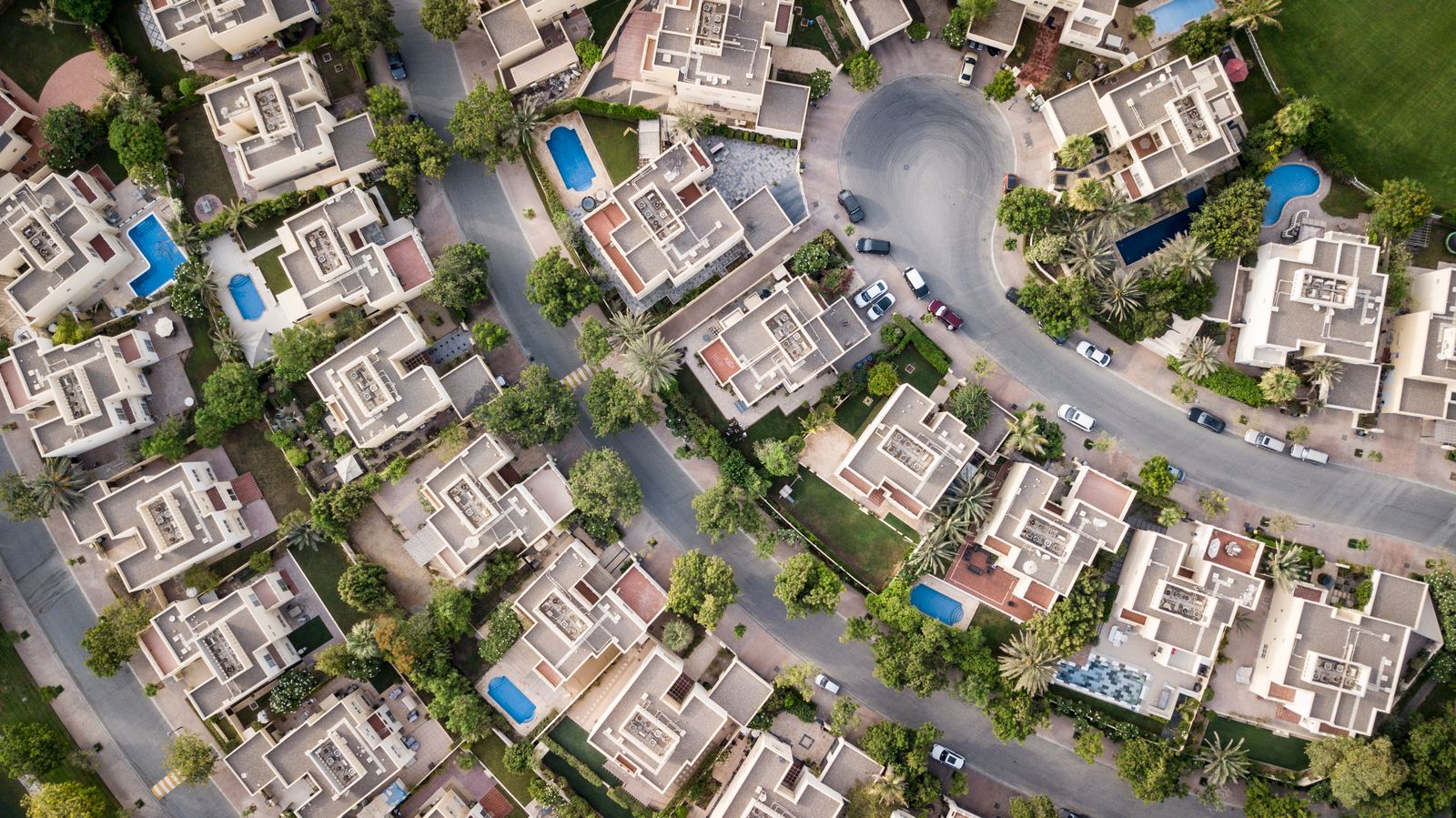
Foreign nationals are widely reported to make up somewhere between 85 and 90 percent of Dubai’s population, with Emirati nationals accounting for a small minority in the emirate they govern — among the highest expatriate shares of any major city in the world. That share is not evenly distributed geographically; specific nationalities and diaspora communities have, over time, anchored specific districts, retail corridors and price bands in ways that are now well-established features of the city’s map rather than recent developments. South Asian communities, among the earliest and largest to settle in the emirate, have long anchored districts such as Bur Dubai, Deira and parts of Karama, alongside a substantial and increasingly affluent presence across newer suburban communities. Communities with roots across the broader Middle East have concentrated in areas from Jumeirah to newer developments in Dubai Hills and Arabian Ranches, often clustering around specific schools, places of worship and retail formats that cater to their communities directly.
More recently arrived communities have followed a similar pattern of concentration rather than dispersion. Buyers and renters connected to Russia and the wider CIS region have been widely reported by agents and market trackers to favour specific towers and communities — Dubai Marina, Business Bay and select Jumeirah Village Circle developments among them — drawn, reportedly, by a combination of price point, existing community presence, and proximity to schools offering relevant curricula. This is, in essence, how immigrant cities have generally worked, in Dubai as much as in London, Toronto or Singapore: new arrivals tend to settle near existing community infrastructure, which in turn attracts further arrivals from the same background, producing self-reinforcing demand in specific buildings and streets that can persist for a decade or more after the community first put down roots.
Business Ownership as a Parallel Pull Factor
Housing policy is only part of what has kept Dubai’s population growing across such a long stretch of time. The city’s free zones have offered full foreign ownership of companies since well before residency reform became a talking point, and a 2021 amendment to the UAE’s Commercial Companies Law extended a similar right — 100 percent foreign ownership, without a local majority partner — to mainland businesses in most sectors. For a relocating entrepreneur or professional, that combination of business ownership, banking access and now long-term residency has made Dubai a place to build a career and a company, not merely a place to hold an investment property, which in turn deepens the kind of long-run housing demand that outlasts any single market cycle.
This matters for how an investor should read the population figures. A city growing primarily because of tourism or seasonal labour would tend to see that growth reverse quickly once conditions changed elsewhere; a city growing because entrepreneurs are relocating registered companies, bank accounts and payroll tends to see that growth prove considerably stickier, because the cost of unwinding a business and a household is far higher than the cost of simply not renewing a rental lease. Dubai’s population curve, sustained through multiple global downturns rather than concentrated in a single boom year, is more consistent with the latter pattern than the former.
What Decades of Inbound Migration Mean for Rental Demand
For an investor evaluating a Dubai purchase primarily as a rental asset, this history carries a fairly direct implication: rental demand in well-established, diaspora-anchored districts tends to be structurally different from demand in purely tourism- or investment-driven pockets of the market. A studio in a short-term-let-heavy tower competes for tenants against every other similar unit in the building, and against the hotel-apartment sector besides; a two- or three-bedroom unit in a community with decades of accumulated diaspora presence competes, in effect, against a smaller and more loyal pool of comparable stock, because tenants in those areas are frequently choosing the neighbourhood as much as the unit — a school run, a specific supermarket, a place of worship, proximity to family or an established social network.
This does not mean diaspora-anchored districts are immune to cyclicality, and rental yields across Dubai still move with the broader market’s supply pipeline and macroeconomic conditions. But analysts covering the residential leasing segment have repeatedly pointed to steadier renewal rates and lower vacancy volatility in communities with long-established resident populations, relative to newer, purely speculative developments — a pattern consistent with tenants who are relocating households rather than simply occupying an investment unit between owners. For a buyer thinking in five- or ten-year terms rather than a single cycle, that steadiness is arguably a more durable asset than any single year’s headline yield figure.
It is also worth noting what this pattern does not guarantee. Diaspora-anchored demand can still soften if conditions in a specific community’s country of origin change enough to pull people back, or if a new, cheaper submarket opens nearby and draws the same tenant pool away; no neighbourhood’s rental base is permanently insulated from competition. What the historical pattern does suggest is that the risk of a sudden, correlated exodus is lower in areas with decades of accumulated community infrastructure than in areas whose tenant base arrived recently and for a single, narrow reason — a distinction worth making explicitly when comparing two otherwise similar buildings on a spreadsheet.
A Relocation Hub, Not a Single Event
It is tempting, particularly in years when a specific inflow makes headlines, to treat Dubai’s role as a destination for relocating people and capital as a story about that one moment. The longer data record argues against that framing. Dubai has functioned as a regional relocation hub — for labour, for capital, for entire families rebuilding a life outside their country of origin — continuously since at least the 1970s, through multiple distinct economic cycles across South Asia, the wider Middle East, the former Soviet space and beyond, each contributing its own layer to the city’s current population and its current buyer base. What changes from decade to decade is the specific origin and scale of the latest wave; what has stayed constant is the underlying mechanism: a stable currency peg, permissive property ownership rules for foreigners in designated freehold areas, comparatively low taxation, and now a residency framework explicit enough that a qualifying purchase can convert directly into a decade of legal status.
For an investor, the useful takeaway is less about forecasting where the next wave of arrivals will originate — a genuinely difficult and somewhat speculative exercise — and more about recognising that Dubai’s buyer base has never depended on a single source. A market built on one nationality’s capital or one community’s migration pattern would be vulnerable to that source drying up; a market that has absorbed and integrated distinct waves from South Asia, the wider Middle East, the CIS region, East Asia and Europe across five decades has, by now, a demonstrated structural capacity to keep attracting the next one, whatever its origin turns out to be. That is arguably a more durable investment thesis than any single statistic about any single year’s population growth.
It is also worth resisting the temptation to read every population data point as confirmation of a single, tidy narrative. Some years of growth owe more to a construction boom absorbing labour, others to a currency or interest-rate shift making Dubai relatively more affordable for a specific buyer pool, and others still to policy changes of the kind described here. The honest summary is less dramatic than any single explanation: Dubai has, for five decades running, been a place that a wide range of people and a wide range of capital have found reasons to move toward, for a wide range of reasons, and the city’s real estate market has been quietly built on the accumulation of all of them at once.
Frequently Asked Questions
What is the significance of Dubai's population growth?
Dubai’s population growth is significant as it has quadrupled in just over two decades, primarily through migration, establishing the city as a global hub for expatriates and businesses.
How has migration influenced Dubai's real estate market?
Migration has greatly influenced Dubai’s real estate market by creating diverse communities, driving demand for housing, and establishing long-term residency linked to property ownership.
What are the main sources of Dubai's population influx?
The main sources of Dubai’s population influx include professionals and workers from South Asia, families from the Middle East, and more recent arrivals from Russia and Europe.
How do diaspora communities affect rental demand in Dubai?
Diaspora communities create stable rental demand in Dubai, as residents often choose neighborhoods based on community infrastructure, schools, and cultural connections, leading to lower vacancy rates.
What role do business ownership regulations play in attracting residents to Dubai?
Business ownership regulations, allowing full foreign ownership, attract entrepreneurs to Dubai, fostering a long-term population that seeks to build careers and families rather than just invest.